
Distribution before wattage.
Parking and area lighting succeeds or fails on where the lumens land. Pole height, spacing, optic, site boundaries, and uniformity are more useful starting points than replacing HID watt-for-watt.
Where are the stalls and drive lanes?
Where must spill light stop?
What light level and uniformity are required?
Perimeter, interior, roadway, or building edge?
Area-light families available to research now
Use current manufacturer family data to compare output packages, optics, mounting, CCT, voltage, photocell/control support, and warranty.

SekTor Area Light

Sabre Series Selectable LED Area Light — 150W Package
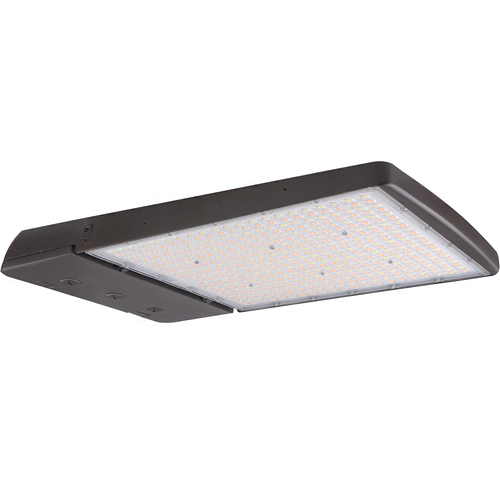
Sabre Series Selectable LED Area Light — 300W Package
Distribution types describe where the light goes.
They are not quality tiers. The correct optic depends on pole location and the shape of the target area.
Roadways, perimeter drives, narrower paths
Parking rows, perimeter poles, many general lot applications
Perimeter poles where light must project into the site
Open areas where coverage is needed around the pole
The same fixture can behave very differently on a different pole.
Document the pole and mounting condition early. It prevents the common mistake of choosing a family that has the right output but the wrong arm, tenon, voltage, or optic.
For site lighting, a layout is often the real specification.
A photometric plan is the reliable way to test fixture count, pole spacing, average/minimum light levels, uniformity, and spill before product is purchased.
Match the required output and distribution—not the old input wattage alone. Existing poles and housings may support either full replacement or a retrofit path.